Mila Goes Missing at the Amusement Park
Chanson douceMila Goes Missing at the Amusement Park begins as a warm September outing and ends in a private, painful compact between a nanny and the child in her care. When Mila vanishes during a picnic, Louise’s frantic search and overwhelming relief at finding her expose the depth of their attachment; Louise’s attempt to hold the child close then becomes frighteningly coercive, and Mila answers with a bloody bite. Their shared silence afterward makes the incident both a rupture and a secret bond.
The outing and the disappearance
At the end of a mild, bright September, Louise decides to take Mila and Adam to the Jardin d’acclimatation. The trip continues a pattern of Wednesday excursions: she draws the children out after school, takes them to parks or to watch fish, and has previously rowed with them on the lake in the Bois de Boulogne. On that outing she told Mila that the floating algae were the hair of a fallen, vengeful witch, turning an ordinary landscape into a story. At the amusement park, Louise runs and plays with the children, buys them ice cream and balloons, and photographs them among vivid yellow and red leaves. Mila asks why some trees turn gold while others nearby seem to go straight from green to dark brown. Unable to explain, Louise says they can ask Myriam. The children scream with fear and delight on the rides. Louise, who is afraid of heights, holds Adam tightly on her knees as the train plunges through dark tunnels and down steep slopes. Later they picnic on the grass beneath the peacocks that frighten Louise. The blanket is an old wool one that Myriam had left rolled beneath her bed; Louise has cleaned and mended it. All three fall asleep together. When Louise wakes, Adam is pressed against her and the children have pulled the blanket over themselves. Mila is gone.
Louise’s search and reunion
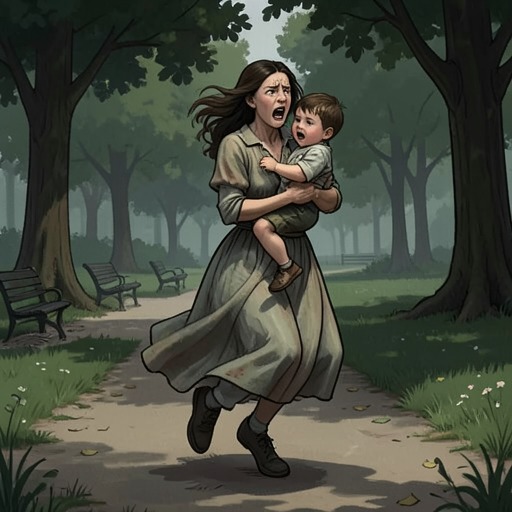
Louise calls for Mila, then begins running through the park with Adam in her arms. People turn to ask whether she needs help, but she does not answer. She searches around the rides and runs past the shooting gallery, looking at the crowds of adults holding their children. Her fear becomes physical: her jaw trembles so violently that she cannot call out, her head aches, and her knees begin to give way. The episode draws out the search before it supplies its answer, making the lost child’s absence felt through Louise’s failing ability to move or speak. She finally sees Mila at the end of an avenue, eating an ice cream on a bench beside a woman. Louise rushes to her and scolds her for wandering off. The older stranger, who has been keeping the girl company, reproaches Louise for leaving a child alone and says she could ask Mila for her parents’ number. But Mila wriggles out of the woman’s embrace, pushes her away, and throws herself against Louise’s legs. The stranger’s accusation meets a visible choice: Mila turns away from her and seeks the nanny.
Relief becomes force
Louise lifts Mila, kisses her cold neck, strokes her hair, and apologizes for her own negligence. She showers the child with endearments and kisses, holding her tightly against her chest. The stranger, seeing Mila nestled in the small blonde woman’s arms, loses her anger. She appears to have expected a public quarrel—perhaps even a scandal involving the parents—and leaves with a final warning that Louise should be more careful next time. As the woman walks away, Louise smiles gratefully, then tightens her grip on Mila. The child says that Louise is suffocating her and tries to break free, kicking as Louise holds her fast. Louise presses her lips to Mila’s ear and, in a calm, cold voice, warns her never to go away again. She describes a kidnapper who would take Mila, hide her, keep her for himself, and leave her unable to see her parents again. The warning is not simply an expression of relief: it turns the danger Louise has imagined into a threat used to frighten the child into staying close. When Louise begins to put Mila down, the girl bites her shoulder. The bite is savage enough to tear the skin and draw blood; Mila remains attached to Louise’s arm like an animal in a frenzy. The reunion thus reverses its tenderness. Louise’s embrace, first a response to terror and relief, has become an attempt to restrain Mila, and Mila’s bite makes her resistance unmistakable.
The secret and its significance
That evening Louise does not tell Myriam either that Mila wandered off or that she bit her. Mila is silent too, although Louise has not warned or threatened her into keeping quiet. Each now has a grievance against the other, and neither exposes the other to the parents. The secrecy creates a peculiar intimacy: Louise and Mila have never felt so united as they do through this concealed incident. Their closeness is real, but it is founded on an unequal relationship and on an episode neither can comfortably name in front of Myriam. The park episode makes caregiving’s double edge concrete. Louise’s attention—bringing the children out, tending to them, comforting Mila—allows her to occupy a place of trust. Yet the panic of losing sight of Mila turns care into possessive force: Louise’s body clamps down, and her speech imagines the child’s separation as abduction and permanent loss. Mila’s response is physical rather than confessional; she does not explain herself but bites, leaving a mark on Louise’s body. Their silence then conceals both the lapse and the violence, preserving their bond while making it more troubling. The outing that began with games, photographs, and a mended family blanket ends with a secret shared by the nanny and child, outside the parents’ knowledge.